Understanding Length Rules for Oversize Tractor-Semitrailer Loads
Federal Law: What the STAA Actually Says
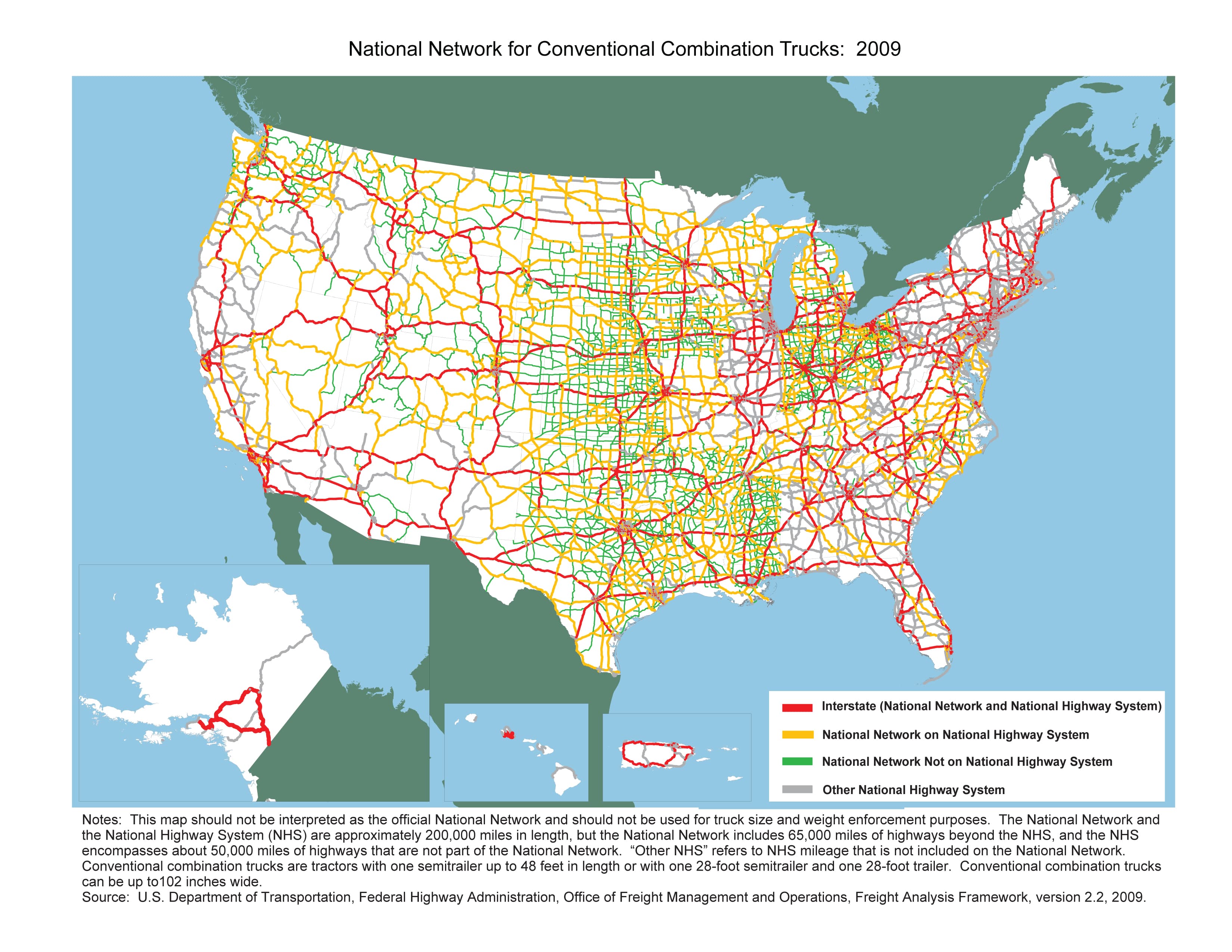
The Surface Transportation Assistance Act of 1982 (STAA) established the federal framework for truck size on the National Network, the Interstate System plus designated federal-aid primary highways. Its implementing regulation, 23CFR Part658, is the law that governs what states can and cannot do with length.
For oversize freight on a standard tractor-semitrailer combination, three provisions matter.
States Cannot Cap Overall Combination Length on the NN
“No State shall impose an overall length limitation on commercial vehicles operating in truck tractor-semitrailer or truck tractor-semitrailer-trailer combinations.”
Source: 23CFR §658.13(b)(3)
On the National Network, there is no federal cap on how long your tractor and trailer can be end-to-end. A state cannot flatly prohibit a tractor-semitrailer combination from exceeding a given overall length on the Interstate.
States do reference overall length thresholds for operational requirements like escorts, travel time restrictions, etc.
In a codified sense, trailer length and overhang are usually what trigger whether you need a permit in the first place. Overall length is then generally what guides the thresholds for escorts, superloads, surveys, and police escorts, though some states do codify those for overhang too. A good way to think about it is that you cannot get to escort-level length without first triggering a permit based on trailer length.
States Cannot Restrict Semitrailers Below 48 Feet on the NN
“No State shall impose a length limitation of less than 48 feet on a semitrailer operating in a truck tractor-semitrailer combination.”
Source: 23CFR §658.13(b)(1)
The federal floor for semitrailer length on the National Network is 48 feet. Most states allow 53 feet, and some states allow longer semitrailers under current state law. For example, Kansas allows 59′6″, Wyoming allows 60′, Oklahoma allows 59′6″, and Louisiana allows 59′6″. Federal Appendix B reflects the grandfathered federal framework, but current state-law allowances may be longer than the Appendix B listing in some states.
The 48-foot floor is why you’ll see states like New York and Maryland with a base trailer limit of 48′, with 53′ allowed on qualifying highways under kingpin distance conditions. The STAA doesn’t mandate 53′ everywhere, it mandates that 48′ cannot be restricted.
Kingpin Rules Enable Longer Trailers, They Don’t Prohibit Them
“If on December 1, 1982, State length limitations on a semitrailer were described in terms of the distance from the kingpin to rearmost axle, or end of semitrailer, the operation of any semitrailer that complies with that limitation must be allowed.”
Source: 23CFR §658.13(c)(2)
Several states regulate trailer length through kingpin-to-rear-axle distance rather than raw trailer length. California’s 40′ kingpin rule, Florida’s 41′, Connecticut’s 43′, and others all stem from this provision.
A kingpin rule is not a trailer length restriction, it’s a geometric requirement that enables longer trailers to operate. A 53′ trailer with a 41′ kingpin distance is legal in a state with a 41′ kingpin rule. The rule ensures the trailer tracks properly through turns. When a state has both a trailer length and a kingpin rule, the kingpin rule is what allows 53′ trailers on the road.
What This Means for Your Load
On the National Network, the two dimensions that most commonly trigger a length-related permit for a standard tractor-semitrailer are:
- The trailer exceeds the state’s legal trailer length. This is the primary trigger. If your trailer body exceeds 53′ (or whatever the state allows), you need a permit.
- The overhang exceeds the state’s legal overhang limit. Some states cap rear overhang independently (Pennsylvania at 6′, Texas at 4′, Oregon at 5′). Exceed the cap, need a permit.
Some states also reference overall combination length as a permit or operational threshold on the NN, though in most practical scenarios the trailer or overhang has already triggered the permit before overall length becomes relevant.
Overall combination length, tractor plus trailer plus overhang, is not independently capped on the NN under federal law. But states commonly use overall length thresholds for operational requirements: escorts, signs, travel restrictions, and in some cases, permit tiers. In nearly all practical scenarios, the permit is first triggered by a specific dimension (trailer length or overhang), and the overall length thresholds layer on additional requirements from there.
When our calculator shows you an overall length result, it’s computed from your inputs and checked against each state’s thresholds. The primary permit triggers come from trailer and overhang dimensions. The escort and condition triggers often reference overall length. Both matter, they just enter the picture at different points.
Off the National Network
Everything above applies to the NN. Off the National Network, states have full authority over length, including overall combination length.
A few states impose real overall combination limits on non-NN roads, which apply to tractor-semitrailer combinations.
This is why road type matters. A vehicle may be fully legal on the National Network but subject to different state rules once it leaves the NN. That said, federal law still protects reasonable access to terminals and service facilities, and generally bars states from denying access within 1 road-mile of the NN absent specific safety-based restrictions on the route.
The Trailer-Includes-Overhang Question
How a state measures “trailer length” determines how your load’s length dimensions interact. Some states measure the trailer body only; overhang is a separate calculation. Other states measure from the front of the trailer to the rearmost point of the load, including any rear overhang.
TRUE (22): trailer length includes overhang/load
FALSE (26): trailer length is body only; overhang regulated separately
This single distinction, whether overhang counts toward the trailer length limit, changes the math entirely. A 53′ trailer with 5′ of rear overhang is either legal (body-only states) or 5′ over the limit (including-overhang states) depending on where you are.
Two specialized hauler classes get their own federally protected overhang treatment, with length provisions measured exclusive of front and rear overhang:
Automobile transporters
“All length provisions regarding automobile transporters are exclusive of front and rear cargo overhang. No State shall impose a front overhang limitation of less than 3 feet or a rear overhang limitation of less than 4 feet. Extendable ramps or “flippers” on automobile transporters that are used to achieve the allowable 3-foot front and 4-foot rear cargo overhangs are excluded from the measurement of vehicle length, but must be retracted when not supporting vehicles.”
Source: 23 C.F.R. § 658.13(e)(1)(ii)
Boat transporters
“All length provisions regarding boat transporters are exclusive of front and rear overhang. Further, no State shall impose a front overhang limitation of less than three (3) feet nor a rearmost overhang limitation of less than four (4) feet.”
Source: 23 C.F.R. § 658.13(e)(2)(ii)
So 3′ in the front, 4′ in the rear is not a universally allowed overhang across all states, it’s specific to these specialized haulers.
Commodity Specific Length Rules
General length limits assume ordinary freight. But when the load falls into a commodity class that a state treats differently, typically poles, pipes, structural steel, timbers, logs, utility material, or other objects that cannot readily be dismembered, the length analysis can change.
In our 48-state dataset, roughly 43 states include some form of commodity-specific length exemption, exception, or alternate treatment. These provisions are not uniform. In some states they create a true exemption from ordinary length limits. In others they allow additional length only under specific conditions such as daylight travel, designated routes, permit-only movement, or commodity-specific caps.
A common pattern in our data tracks model-code style language covering poles, pipe, machinery, or other objects of a structural nature that cannot readily be dismembered. In many of those states, the ordinary length rule is relaxed for qualifying loads, often subject to conditions such as daylight-only travel, route limits, or maximum object and overall lengths.
Examples from our data include:
- Alabama (§32-9-25): poles, logs, lumber, structural steel, and piping exempt from ordinary length limits
- California (CVC 35414): poles, timbers, pipes, missile components, aircraft assemblies, drilling equipment, and tanks up to 80′ treated under a separate commodity-specific rule
- Tennessee (§55-7-203(f)): poles, logs, and timber in single-length pieces allowed up to 75′ overall
- Oregon (Division 78): long logs and piling allowed up to 120′ overall on designated routes
- Nebraska (§60-6,290(2)(e)): public utility and construction or maintenance material treated under a separate exception to the general length rule
Other recurring carve-outs in our data include tree-length logs, oilfield equipment, stinger-steered auto transporters, and manufactured housing.
These rules are captured in the special_commodities_length note for each state’s data file. Refer to the per-state notes for the exact commodities, caps, route restrictions, and operating conditions that apply.
Source: 23CFR Part658, “Truck Size and Weight, Route Designations: Length, Width and Weight Limitations,” implementing the Surface Transportation Assistance Act of 1982 (STAA). Current version available at ecfr.gov.