How to Think About Pricing an OSOW Load
A legal flatbed load is priced on miles, market, and timing. An oversize load has all of that plus five cost layers that don't exist in legal freight.
Friction
You can't move without permits and escorts. Every state on the route has its own application, fees, and timeline. Some issue in minutes, some take days. Escorts need to be sourced. Every touchpoint is a place where the move can stall.
Risk
A height strike, a load shift, a wrong turn onto a restricted road. These aren't cargo claims, they're highway closures and infrastructure damage. Insurance premiums reflect this.
Effort
OSOW loads are project-managed The driver is executing a specific plan on a specific route with specific conditions and laser focus.
Speed
Most states restrict oversize to daylight only. Many ban weekend travel above certain dimensions. A route that takes one day legal can take three days permitted. And the trucks are literally just slower.
Equipment
A step deck is commodity equipment. An RGN is less common. A 13-axle perimeter frame is rare. The more specialized the trailer, the fewer exist, the more they cost to own, and the more they cost to buy and run.
The OD Premium
A step deck running legal loads in the Southeast might run at $3.50/mile. That's the floor.
An OSOW load on that same equipment, in that same lane, needs to clear a higher bar. "What rate makes it attractive enough to compensate for the friction, risk, effort, speed penalty, and equipment demands that this load creates?"
The amount above the legal baseline is the OD premium.
Small OD premium
A 10′6″ wide load on a step deck with one escort. The friction is a permit. The speed hit is minor. The effort is manageable.
~$1.50–2.50/mile above baseline
Large OD premium
A 15′ wide, 150,000-pound GVW on a 13-axle setup with two escorts and possible law enforcement detail. Multi-state permits that take days. Daylight-only with metro curfews. Possibly route survey and engineering analysis.
$10–15+/mile above baseline
The OD premium scales with every factor. The wider, heavier, longer, and more state lines you cross, the more each factor compounds. A load that's slightly oversize in one state is a rounding error. A load that's superload-class across six states is a logistics operation.
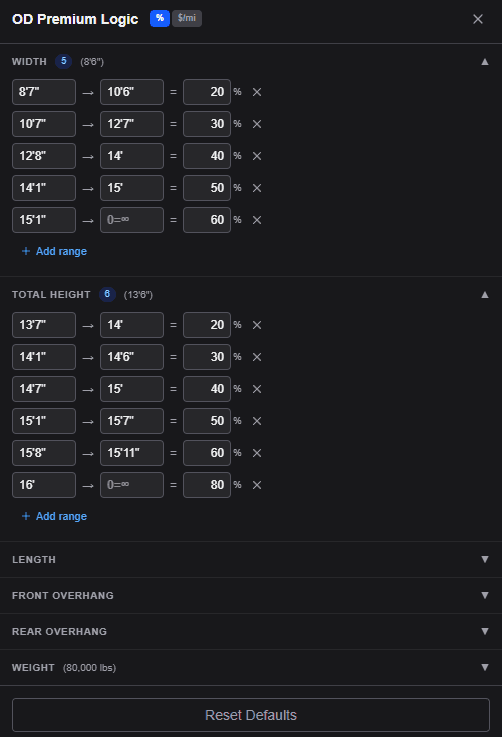
The carriers and brokers who make money in OSOW are the ones who accurately size the OD premium for each load.
Underprice it and you're subsidizing the move with your legal freight profits. Overprice it and you lose the bid. The key is knowing exactly what each state requires permits, escorts, conditions, et cetera so you can quantify the friction, risk, effort, speed, and equipment demands instead of guessing.
You give it the load dimensions and the route. It tells you, state by state, what's required. You take that output and size the OD premium based on what you know about your equipment, and the market.
Permit fees, escort requirements, and travel restrictions referenced in this article are sourced from current state DOT regulations across all 48 contiguous states.